Vampire exclusion from churches and sacred objects
The Tale of the Vampire BrideVampire exclusion from churches and sacred objects is presented as a consequence of becoming a vampire that reaches beyond physical danger: Ignatius loses access to his crucifix, his church, and the divine presence he once knew. His experience gives the rule its clearest form, while other scenes set Christian prayer and devotional objects beside the story’s competing rites of blood without establishing a universal effect for every sacred object.
The Rule in Ignatius’s Experience
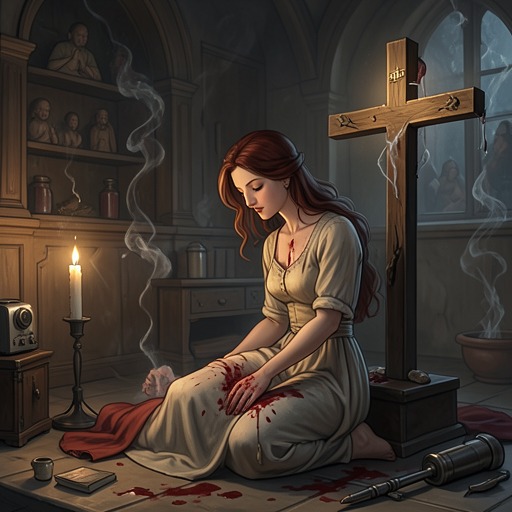
Ignatius recounts that his transformation began when a woman he had sheltered asked him for a kiss, bit his throat, and drank until his heart nearly failed. She then invited him to drink from her, and he did. On awakening, he found that he could no longer touch his crucifix or enter his church. He also no longer felt God’s loving presence. The change therefore excludes him in several connected ways: he is physically barred from contact with a central Christian object and from entering a sacred place, and he experiences the loss as spiritual separation.
Ignatius does not describe the exclusion as a temporary inconvenience. He understands it as a rupture from everything he had held dear. His response is to swear to do penance until God restores the divine presence and returns him to service. Yet the account gives no indication that penance reverses the prohibition: he says he continues to serve the woman and her husband while pursuing salvation as a personal quest. His story links the rule to both the bodily fact of vampirism and the religious guilt through which he interprets his new existence.
Sacred Devotion Beside the Blood Rite
The narrative places this exclusion within a household still marked by Christian devotion. When Antoinetta Wright prepares to give blood to Glynis Wright, she first genuflects, kisses her rosary, and buries it in a small hole in the dirt. She promises to pray to the Father, the Son, and the Holy Spirit and to beseech the Blessed Virgin to watch over her daughter. She then urges Glynis to drink and live. The scene does not say that Antoinetta is unable to carry or touch the rosary, or explain why she puts it away; it instead makes prayer and the rosary part of her final, deliberate act of maternal care as she gives blood to sustain Glynis.
A later transformation scene makes the contrast with Christian sacramental imagery more pronounced. Vlad Dracula repeatedly pours blood from a goblet for Glynis, while her sisters support her; he then lowers her into the blood, and her wounds fade as her senses sharpen and her heart begins to beat. This is a vampire rite of renewal, not a demonstrated encounter with a sacred object. Set against Antoinetta’s prayer and Ignatius’s loss of access to church and crucifix, it shows the story placing Christian devotion and vampire blood-giving in tension without claiming that they operate by identical rules.
Limits of the Evidence and Narrative Significance
During the villagers’ assault on Dracula’s castle, a priest chants while the gypsy guards approach and one of them wrestles a crucifix from his grasp. The narration emphasizes that the priest is fighting mortals, not vampires. The scene thus does not show whether a vampire would be repelled or injured by the crucifix; its relevance is the distinction it draws between human attackers and the supernatural danger surrounding the castle.
The evidence most firmly establishes Ignatius’s inability to touch a crucifix or enter a church, and his sense of spiritual estrangement after becoming a vampire. It does not specify the effect of every sacred object, explain the mechanism behind the exclusion, or show whether all vampires experience it in the same way. The rule nevertheless gives vampirism a religious cost in addition to its physical and social consequences: for Ignatius, becoming undead means not only serving a new supernatural order but also losing ordinary access to the places and objects through which he once approached God.